




Introduction
ERP systems have always promised a single source of truth for finance, procurement, supply chain, HR and operations. But as business complexity grows, traditional ERP automation often hits a ceiling. The integration of AI in ERP systems enhances these mission-critical platforms, making them more predictive, adaptive and supportive for users.
Yet, it still requires manual, human input to:
- Complete the execution of key ERP processes
- Derive insights and turn them into action
This guide provides an overview of the major types of AI used in ERP today, explains the measurable benefits organizations can realize from AI and highlights practical use cases that consistently deliver value across departments. Additionally, it explores the future of AI for ERP systems — Agentic AI ERP.
How AI is used in ERP systems
AI is used in ERP systems to integrate the various applications and modules connected to the ERP via APIs, events, workflows, extensions, analytics tools and automation. After consuming ERP and system-related data, it detects patterns, predicts outcomes, classifies information and recommends best actions.
Though AI has proven useful in ERP systems, it’s still primarily assistive. How far it can go depends largely on the underlying techniques being applied. Understanding those building blocks — starting with the different types of AI commonly used within ERP environments — helps clarify both today’s capabilities and tomorrow’s possibilities.
Types of AI used in ERP systems
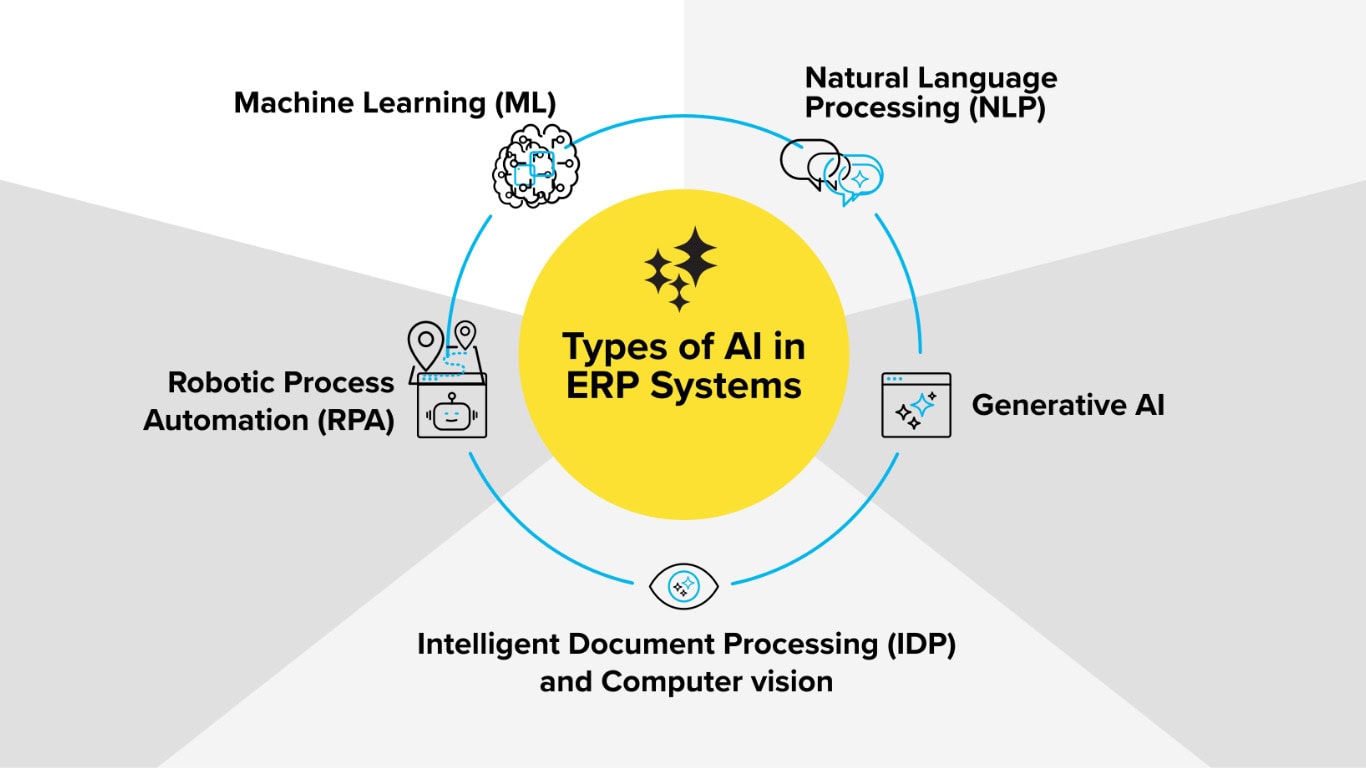
The different types of AI used in ERP systems include machine learning (ML), natural language processing (NLP), computer vision and intelligent document processing (IDP), robotic process automation (RPA) and generative AI. Pinpointing how these types of AI enhance ERP functions can demonstrate their practical value in real-world scenarios.
Below is a breakdown of each type of AI in ERP, including what they’re best at and where they typically need additional workflow support to create measurable business impact.
ML
ML learns from historical ERP and operational data, using identified patterns to predict outcomes and recommend actions.
In ERP contexts, ML often powers:
- Forecasting: It can predict demand, cash flow, inventory and staffing needs.
- Anomaly detection: ML can identify anomalies in ERP data, such as unusual invoices, suspicious transactions and pricing outliers.
- Classification: ML excels in classifying data such as spending categorization, case routing and supplier risk tiers.
- Recommendations: It can enable helpful recommendations such as reorder points, next best action for exceptions and approval prioritization.
ML is especially valuable where rules are brittle— for instance, when the right answer depends on context, seasonality or subtle signals.
Practical limitation: ML typically recommends rather than executes. It can determine what’s likely to happen or what should happen next, but workflows still need further orchestration to carry actions through approvals, exceptions and handoffs.
NLP
NLP enables systems to interpret human language and other unstructured content — including emails, chat messages, PDFs, policies and notes — so ERP-adjacent work becomes easier to search, summarize and route.
In ERP contexts, NLP commonly supports:
- Document understanding: NLP can extract terms from invoices, contracts and purchase orders.
- Search and Q&A: NLP is used to find policies, procedures or transaction context quickly.
- Summarization: It can summarize data for users, including condensing approval histories, case notes and exceptions.
- Intent detection: NLP can also identify what a user needs, such as checking the status of a purchase order or updating a vendor profile.
A particularly useful application of NLP in ERP systems is chatbots and virtual assistants, which use NLP to provide support and answer questions, thereby improving the customer and employee experience through real-time assistance.
Practical limitation: NLP can streamline understanding and support, but complex cases still require structured workflow steps and human intervention to complete work.
Computer vision and IDP
Many ERP processes still rely on physical documents, such as scanned invoices, packing slips, tax forms or handwritten delivery records. IDP combines OCR (optical character recognition) with AI extraction and validation to turn those documents into usable, structured data.
In ERP contexts, IDP can be used for:
- Data capture: IDP can reliably capture data from invoices, receipts and forms at scale.
- Validation: It can validate line items against POs and master data.
- Exception routing: IDP can route exceptions to the appropriate queue when information is missing, inconsistent or against policy.
Practical limitation: IDP can capture and validate data, but downstream resolution still depends on workflow design (i.e., who reviews, who approves, what triggers escalation and how corrections flow back into the ERP).
RPA
RPA automates repetitive, rule-based tasks across multiple applications to execute important ERP processes. It addresses steps that teams would otherwise have to handle manually, saving significant time and effort.
In ERP contexts, RPA is commonly used for:
- Cross-system data share: RPA can assist with moving data between systems when APIs aren’t available or practical.
- Standardized actions: It can perform high-volume, standardized actions, such as updates, reconciliations and validations.
- Gap closure: RPA can help bridge workflow gaps between and across ERP and surrounding tools.
Practical limitation: RPA is great at doing, but not at deciding. Though it can execute steps when rules are clear, it usually needs ML/NLP/analytics inputs — coupled with human or workflow controls — when judgment, context or exceptions are involved.
Generative AI
Generative AI produces text, code or structured outputs based on prompts. This form of AI is most effective when it’s used with strong governance and grounded in trustworthy enterprise data.
In ERP contexts, generative AI can help support:
- Email drafting: Generative AI can be used to draft supplier emails and operational communications.
- Summarization: It can assist with summarizing incidents, case histories and exception context.
- Restructuring: Generative AI can produce structured outputs from messy inputs — when, of course, guardrails and validation are in place.
Practical limitation: On its own, generative AI is typically a “drafting and summarization” engine, but it still requires a human touch to ensure output quality and accuracy.
How AI improves ERP processes
There’s debate about the value of AI for ERP, primarily around ROI and impact on top and bottom line. A pragmatic way to evaluate it is to look at the measurable changes that occur when AI is applied to ERP processes — from fewer bottlenecks and errors to better decisions and less manual effort across departments.
In other words, AI creates value when it goes beyond just “adding intelligence,” to now improving the throughput, quality and responsiveness of ERP workflows. The most common benefits tend to fall into four core outcomes:
1. Speeds up cycle times and improves throughput
AI can reduce the time work sits in queues by streamlining steps that otherwise slow execution. In practice, this means approvals are accelerated, ticket backlogs across departments shrink and payments from suppliers and customers can be collected faster.
2. Sharpens accuracy and reduces exceptions
AI can improve accuracy in key business processes by detecting anomalies early and reducing manual data entry — two major drivers of downstream rework. It can flag issues in important data, thereby lowering the likelihood of errors, and quickly explore large datasets to draw conclusions that would be difficult or time-consuming for users to find on their own.
3. Improves forecasting and decision quality
The ability to act quickly is hindered when teams rely on static rules or spreadsheets. AI can incorporate broader signals and detect shifts faster, improving forecasting and strengthening overall decision-making.
4. Enhances the employee experience
AI for ERP can enhance the employee experience by resolving employee tickets faster and streamlining onboarding. More broadly, AI can automate repetitive tasks and reduce friction in everyday work, thereby increasing employee satisfaction.
Use cases and examples of AI in ERP processes
The application of AI for ERP processes has manifested in various ways, reshaping how work gets done across the enterprise. And it’s just the beginning. As forward-thinking leaders experiment, expand and connect these capabilities, the possibilities for improving outcomes become virtually endless.
The following are some common use cases and examples of AI in ERP processes, organized by department:
Finance departments
Finance teams operate in a world of high volume, high accuracy requirements and constant audits. AI can help solve common issues in critical finance processes within ERP systems effectively, enabling teams to focus on higher-impact decisions rather than manual triage.
ERP processes that AI can assist with include:
- Invoice anomaly detection: AI in ERP can flag duplicates, unusual amounts or suspicious vendor patterns, helping finance teams identify and resolve problems with invoicing quickly.
- Cash flow forecasting: AI can improve projections by looking at behavior and seasonality signals, then making projections based on these metrics to help finance teams understand cash flow.
- Collections prioritization: AI can recommend an outreach order to customers and suppliers based on the greatest likelihood –to pay, increasing the probability of collecting payments promptly.
These use cases often succeed because they’re measurable. Cycle time, error rates and exception volumes are easy to track.
Procurement teams
Procurement teams manage constant trade-offs — such as cost, risk, availability and compliance — across an ever-growing supplier ecosystem. AI can help address common friction points in procurement processes within ERP systems, improving visibility and consistency while reducing manual effort.
Tasks that AI can assist with include:
- Spend classification: AI can categorize purchases even when descriptions aren’t standardized or consistent.
- Supplier risk analysis: It can predict late deliveries or quality issues based on supplier history.
- Contract detail extraction: Teams can use AI to extract terms of important contracts, including renewal dates, obligations and penalties.
Use cases like these are popular among organizations because they help cut down on manual effort and mitigate procurement-related risk.
Supply chain teams
Supply chain is where AI often shines because variability is the norm — from fluctuating demand to supplier disruptions and logistics constraints. Integrating AI can help provide greater stability by surfacing both past and present insights and enabling teams to apply those insights accordingly.
AI can assist in common processes among supply chain teams, such as:
- Inventory optimization: AI can adjust safety stock levels and reorder points based on demand volatility and historical trends.
- Logistics optimization: AI can help with route planning and provide a detailed analysis of cost and service trade-offs.
- Shipment block management: AI can identify and address shipment holds and logistics exceptions for faster resolution.
- Demand forecasting: AI can incorporate external signals, seasonality and product lifecycle data to improve forecast accuracy.
These use cases are notable because they directly affect service levels, inventory costs and fulfillment performance — metrics that are closely monitored by supply chain leaders.
HR teams
HR teams handle a high volume of employee interactions while having to balance compliance, consistency and service quality. The use of AI is less about “replacing HR” and more about streamlining processes to improve response times and reduce case backlog.
Some of the ways AI can assist HR teams include:
- Case summarization: AI can summarize employee case histories and document next steps, decreasing handle time for HR tickets.
- Document intake automation: AI in ERP can pull and validate information from employee-submitted forms, reducing manual data entry.
- Workforce insight generation: AI in ERP can be used to analyze workforce data to identify attrition risks and optimize staffing.
These use cases succeed because improvements are visible. Case resolution time, backlog reduction and employee satisfaction scores provide clear signals of impact.
The future of ERP — Agentic AI ERP
AI has already proven its value when added to ERP systems. However, it has one major limitation: Most AI in ERP today stops short of execution. It’s purely assistive, meaning that it can analyze, summarize and recommend, but a human still needs to orchestrate the rest of the workflow.
- Example 1: When finance teams want to forecast cash flow, AI can analyze payment history, seasonality and trends to produce forecast ranges. But after that, a person must look at those forecast ranges to determine liquidity actions and adjust assumptions as needed.
- Example 2: AI can power an HR chatbot that answers common employee questions and pulls from approved knowledge sources. But this chatbot is unable to handle or resolve complex cases that need human intervention.
Agentic AI ERP takes ERP potential to the next level. Rather than just assisting with individual tasks, it facilitates end-to-end process execution, enabling ERP workflows to move forward seamlessly with minimal human intervention — all while still operating within defined rules, controls and audit requirements.
What is Agentic AI ERP?
Agentic AI ERP reinvents the way critical business processes are executed. It transforms the concept of ERP from a linear, transactional “System of Record” to a “System of Action” with Agentic AI capabilities. The ERP becomes an important contributor to a federated enterprise data fabric, but not a sole source.
In this model, Agentic AI deploys intelligent electronic “agents” that can think like humans and autonomously set goals, make decisions and take action in pursuit of those goals. This can be done regardless of where data or application logic resides.
What can Agentic AI ERP do in practice?
Organizations can leverage Agentic AI for ERP across core modules and business areas to elevate operations with AI agents.
Examples of specific processes that Agentic AI ERP can automate include:
- Creating and approving procurement requisitions: Agentic AI can create and approve purchase requisitions that require policy and budget validation.
- Streamlining vendor onboarding: Agentic AI can facilitate end-to-end vendor setup in ERP systems, including compliance checks and approvals.
- Assisting in vendor selection: Agentic AI can help teams select the right vendors by providing recommendations based on detailed data.
- Managing eTenders: Agentic AI can streamline the intake, coordination, evaluation and award of RFQs and tenders.
- EDI resolution: Agentic AI can assist in the detection, diagnosis and resolution of failed or blocked EDI transactions.
- Expense reimbursement: Agentic AI can simplify the submission, validation and approval of employee expenses.
- Sales commission management: Agentic AI can be leveraged to calculate sales commission amounts and monitor company commission policies.
- Financial reconciliation: Agentic AI can identify and resolve financial reconciliation variances, ensuring accuracy in calculations.
This list isn’t exhaustive, as new solutions are constantly being created. Additional examples can be found in the “Rimini Agentic AI ERP Solutions” catalog.
What are the benefits of Agentic AI ERP?
Agentic AI ERP unlocks enterprise-wide AI value without replacing or upgrading existing ERP systems. By layering intelligent AI agents on top of stable ERP platforms, organizations can retain their reliable, customized, fully depreciated releases — along with their highly valuable perpetual licenses — while accelerating innovation.
Unlike vendor-provided AI in ERP, which is siloed and often requires a lengthy migration or upgrade to access, Agentic AI ERP enables faster time-to-value — measured in weeks, not years — by delivering AI capabilities across the enterprise ecosystem to orchestrate end-to-end workflows. With it, organizations can run processes faster, better and cheaper, without disrupting operations or their technology stack.
Get ahead of the curve with Agentic AI ERP
Agentic AI ERP represents a practical inflection point for leaders: harnessing the power of AI and automation to enhance critical business processes without replacing core ERP systems, while setting the foundation for more autonomous, scalable operations.
Our latest white paper, “The Rise of Agentic AI ERP,” provides a deep dive into Agentic AI ERP, covering key points such as how ERP systems are evolving, what limitations exist in traditional ERP and how Agentic AI transforms ERP processes. Read the white paper now.
FAQs
What is AI in the context of ERP?
AI in ERP is the integration of AI technologies such as machine learning (ML), natural language processing (NLP) and predictive analytics into ERP systems to streamline workflows, automate important ERP processes, enhance decision-making and improve operational efficiency.
What’s the difference between AI in ERP and Agentic AI ERP?
AI in ERP helps users by drafting, summarizing and recommending. Agentic AI ERP can plan and execute multistep workflows across systems with guardrails, approvals and audit trails, making it suitable for orchestrating exceptions and operational coordination.
Do I need a new ERP to benefit from Agentic AI ERP?
No, organizations don’t need to invest in a new ERP system to benefit from Agentic AI ERP. It’s just a matter of having a solid ERP foundation in place. Agentic AI capabilities can be layered on top of existing, stable ERP platforms via integrations, analytics layers, automation tools and workflow extensions. The best approach often depends on the organization’s unique architecture, security requirements and modernization roadmap.
What are the easiest AI use cases to start with in ERP?
High-volume, exception-heavy workflows tend to produce fast ROI, such as invoice processing, spend classification, forecasting improvements, case management summarization and automated triage or alerts. When it comes to use cases for Agentic AI use cases in ERP, start with one in which you can measure cycle time, exception rates or cost per transaction. Choose one workflow to improve at a time, then introduce more workflows from there.