




Is migrating Oracle EBS to Fusion Cloud the right move?
Oracle Fusion Cloud is positioned as the next generation of ERP for Oracle EBS customers — with an updated user experience (UX), continuous updates, embedded analytics and AI-enabled capabilities.
But the question isn’t whether Fusion is modern — it’s whether migrating delivers enough value to justify the investment, disruption and loss of flexibility.
The fact is, an ERP migration isn’t a simple upgrade. It’s a multiyear transformation effort that impacts processes, integrations, reporting, security models and operating structures. Successful execution requires significant time, funding and organizational alignment. And as such, it may not be the right move for every organization.
This guide explores:
- What organizations must evaluate before committing to migration
- Why outcomes, not platforms, should guide decision-making
- How enterprises can achieve business outcomes on existing EBS environments
- What practical alternatives to Oracle EBS migration are available
With these insights, IT leaders can determine what to do next — based on their organization’s needs, not vendor pressure.
When considering Oracle EBS to Fusion migration, start by decoupling technology from business needs
Before considering whether an Oracle EBS to Fusion migration is worth pursuing, organizations should start by outlining their desired outcomes. For example, common objectives include — but aren’t limited to — improving operational efficiency, increasing business agility and reducing IT operating costs.
Once the specific business outcomes are clearly defined, the next step is to evaluate whether migration is the most efficient path to achieving them based on several key factors.
Potential risks
Every ERP replatforming project introduces risk — particularly for large, complex environments. And an Oracle EBS to Fusion migration is no exception.
When undergoing a migration, organizations frequently run into:
- Longer-than-expected timelines, often driven by data complexity, integration dependencies and scope expansion
- Budget overruns, as implementation, testing and change management efforts can exceed original estimates
- Business disruption during transition, including productivity slowdowns or temporary service interruptions
- Integration and data challenges, especially when rebuilding interfaces or reconciling historical and regulatory data
Birmingham City Council’s Oracle project is a prime example of migration failure, with extended timelines and budget overruns driven by the need for customizations and manual workaround labor, as well as by the migration itself. In addition to costing more than seven times the earlier estimates, the move from SAP to Oracle Fusion has been delayed by more than five years, leaving the council without the fully functioning system it needs.1
Given the impact a migration can have on day-to-day operations, IT leaders should perform a thorough risk assessment before committing to a Fusion move.
TCO
Understanding TCO is essential when evaluating migrating Oracle EBS to cloud. But it requires leaders to look beyond surface-level pricing.
A common misconception is that subscription costs represent the total Fusion investment. In reality, the shift to SaaS fundamentally changes the financial model. Organizations move from a largely predictable, owned Oracle EBS asset to a “rented” Fusion platform with ongoing and fluctuating costs. This shift also reduces flexibility, with high barriers to exit, locking organizations into the vendor’s roadmap and pricing structure.
TCO also extends well beyond the initial program. Fusion environments require continuous investment to maintain performance and business alignment. Regular updates introduce recurring testing and governance demands, while evolving business needs can drive additional configuration, integration and optimization work over time.
On top of this, organizations frequently underestimate indirect cost considerations. For example, internal teams may need to be reskilled, and reliance on external partners may go on longer than expected.
Taken together, these factors reinforce that TCO isn’t just about what migration costs to complete but also about what it costs to operate, maintain and evolve the platform in the long run.
How much does an Oracle EBS to Fusion migration typically cost?
The cost of an Oracle EBS to Fusion migration varies widely based on organization size, complexity and approach. But in all cases, it’s a substantial, multilayered investment.
Key costs include:
- Licensing (subscription)
- Implementation services
- Data migration
- Integration redesign
- Reporting development
- Testing cycles
- Training and change management
Benchmark estimates illustrate how quickly costs can add up. According to ERP Research,2 small organizations with fewer than 500 employees can expect to pay anywhere from $2M to $5M on licensing, $1.5M to $4M on implementation and $3.5M to $9M for TCO. Large organizations with 10,000 or more employees may pay from $15M to $50M on licensing, $20M to $80M on implementation and $35M to $130M for TCO.
As IT budgets are usually limited, it’s not uncommon for migrations to consume a sizable portion, leaving little left over for other high-priority projects — an important point for IT leaders to factor into Oracle decisions.
ROI
Not all Oracle EBS migration initiatives deliver the expected ROI. Selecting the right path forward depends on which option will generate the greatest business value with the least risk and cost.
ERP vendors such as Oracle often promote cloud platforms as inherently cost-effective and future-proof. But real ROI depends on whether migration enables outcomes that can’t be achieved more efficiently in the current EBS environment.
Leaders should take the time to address the following questions:
- Are projected benefits tied to actual process improvements, or are they assumed as a result of moving to the cloud?
- Can hard financial gains, such as reduced operational overhead or improved transaction efficiency, be clearly calculated?
- Will productivity improvements meaningfully offset the cost and disruption of the migration — for example, through faster revenue-generating activities?
It’s also important to distinguish between measurable gains and more strategic benefits. Improvements such as increased agility and better talent attraction are valid, but they’re also harder to quantify and easier to overestimate.
Ultimately, ROI should be evaluated in terms of time-to-value and total value delivered. If similar outcomes can be achieved faster and at lower cost within the existing environment, an Oracle EBS to cloud migration may not be the best investment.
Skills and talent transitions
An Oracle EBS to Fusion migration fundamentally changes how both IT and business teams operate.
With this move, the operating model shifts from system ownership to service consumption. Therefore, teams are no longer managing a highly customizable system; they’re working within a standardized SaaS environment — one that requires different skills, tools and ways of working.
This affects multiple roles across the organization. Functional leaders, for instance, must learn new configuration models and processes. Developers have to move toward extensions, APIs and integration platforms, while testing teams must adapt to continuous updates rather than periodic upgrade cycles.
The transition brings with it both opportunity and risk. Though cloud skills are valuable, organizations need to plan for:
- Temporary productivity loss while teams learn the new system
- Overlapping skills requirements during migration
- Increased reliance on system integrators or managed service partners
Without a clear talent strategy, these challenges can extend timelines and increase costs. That’s why team readiness should be treated as a crucial migration consideration — not an afterthought.
Data, controls and audit considerations
Data migration is one of the most underestimated aspects of any major ERP project — including a move from Oracle EBS to Fusion — and one of the most critical to get right.
Organizations must address factors such as:
- Historical data retention, including what to migrate, archive or retire
- Master data cleansing, to ensure consistency and accuracy in the new system
- Financial and regulatory reconciliation, particularly in highly regulated industries
Along with the data itself, controls and audit structures need to be revalidated in the new environment. That means reestablishing segregation of duties, ensuring auditability of transactions and confirming that control frameworks meet internal policies and external regulatory requirements.
For many enterprises, these considerations can directly influence migration strategy, sequencing and overall feasibility.
Oracle Fusion migration: Expectations vs. reality
Though Oracle EBS to Fusion Cloud migration may be positioned as a route to innovation, it’s not uncommon for organizations to encounter challenges along the way. Below are just some of the issues IT leaders can run into unexpectedly.
Ongoing operational demands
Migrating from Oracle EBS to Fusion doesn’t reduce operational responsibility — it only reshapes it.
Once the move is completed, organizations must continuously manage a dynamic SaaS environment. This includes:
- Adapting to frequent release cycles
- Revalidating integrations as updates occur
- Retraining users on new features
- Closely monitoring business impact
And unlike traditional upgrades, these activities are ongoing — not periodic.
Ensuring successful performance in this new environment requires strong governance, clear ownership and disciplined processes. If organizations aren’t fully prepared, the operational burden can strain and break internal teams and processes over time.
Delayed AI value realization
Many organizations pursue Fusion to gain access to Oracle AI capabilities — but the timeline to realize that value is often longer than expected.
Oracle’s newest AI capabilities are generally tied to Fusion, OCI and related Oracle cloud services. If migration takes several years to complete, the ability to fully leverage Oracle’s AI can be delayed by the same timeframe — possibly longer since the new system must be stabilized. As a result, organizations could absorb years of cost and disruption before realizing maximum benefits from AI. For EBS customers, there are other Agentic AI options that are indirect, deployed outside and around the EBS core.
For leaders under pressure from boards to deliver near-term AI outcomes, this creates a disconnect. Migrating for future capabilities may not align with immediate business priorities, especially when alternative approaches can enable AI, automation and cross-system orchestration around Oracle EBS systems today.
Forfeiture of perpetual licenses
An Oracle EBS to Fusion Cloud migration can fundamentally change the licensing, cost and control model. While customers may retain their perpetual EBS licenses on paper, they typically stop using and receiving full support for those licenses as they move to SaaS subscriptions.
That practical shift basically turns a long-owned strategic asset into an ongoing subscription commitment, which can make long-term costs harder to predict. In cases where a customer’s EBS license rights have been altered, flexibility may be reduced because reversing course after switching may not be a viable option.
Additionally, migration can deepen lock-in to Oracle’s ecosystem and roadmap, limiting future optionality. Over time, this increases financial, commercial and technical dependency on Oracle, hindering the ability to adapt strategy as business needs evolve.
For many organizations, this change raises an important strategic consideration: the long-term implications of reduced control and increased vendor lock-in. As a result, a growing number of leaders are rethinking Oracle EBS upgrades and migrations altogether.
Is an Oracle EBS to Fusion Migration actually necessary?
The answer to whether an Oracle EBS to Fusion migration is necessary isn’t so straightforward.
The move could be justified in specific scenarios — such as aggressive standardization initiatives, SaaS-first mandates or intentional redesign of operating models around cloud-native processes.
However, these cases are usually rare.
Most organizations consider migration to achieve outcomes like:
- Better automation
- Improved analytics and reporting
- Enhanced UX
These are valid goals, but they raise a more important question: Do you need to replace or even upgrade your Oracle EBS system to achieve them?
In many cases, the answer is no.
Innovation without Oracle EBS to Fusion Cloud migration
Many organizations are realizing that an Oracle EBS to Fusion Cloud migration isn’t the best way forward.
Challenging the “inevitability” assumption
For years, Oracle’s narrative has been clear: Moving to the cloud, specifically Fusion and OCI, is the expected next step. But that assumption is increasingly being challenged.
A growing number of enterprises are shifting their focus away from platform replacement and toward outcome-driven modernization. Instead of asking, “When do we migrate?” they’re asking, “What outcomes do we actually need, and what’s the most efficient way to achieve them?”
Often, the answer doesn’t require a full migration to Fusion.
By keeping Oracle EBS as the reliable, stable system of record and modernizing around it, organizations can capture much of the value typically associated with Fusion — without incurring the cost, risk and disruption of a multiyear Oracle EBS to cloud migration.
The value of outcome-driven modernization
Rather than undertaking a full-scale migration, enterprises can unlock meaningful improvements by modernizing around their existing EBS environment. This approach focuses on delivering specific business capabilities — quickly and with less risk — without touching the underlying system.
With this approach, organizations can gain:
- Enhanced UX: Improvements in UX delivered through role-based interfaces, guided workflows and self-service portals layered on top of EBS
- Process automation: Automation through workflow orchestration and Agentic AI without altering core ERP logic
- Advanced analytics and insights: Modern data platforms and pipelines for real-time reporting and forecasting
- AI-driven innovation: Predictive models, natural language interfaces and decision automation integrated alongside EBS
- Cost optimization: Improved operations, customization rationalization and alternative support models to further extend EBS viability while lowering TCO
Many of these capabilities depend more on data architecture, integration strategy, workflow orchestration and operational design than on the platform itself — rendering the assumption that migration is necessary for modernization and innovation obsolete.
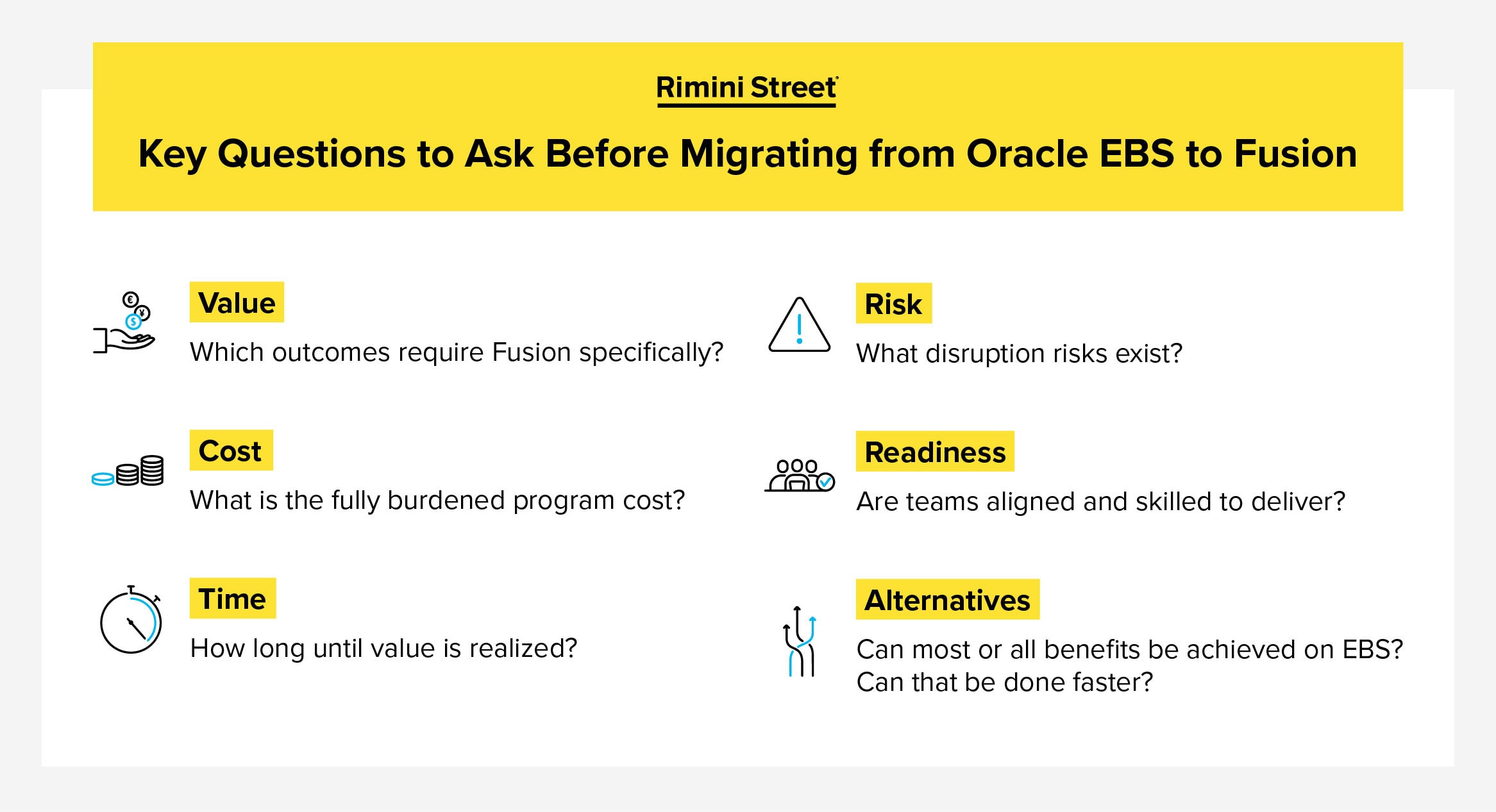
A practical decision framework for Oracle EBS to Fusion migration
Key evaluation questions:
- Value: Which outcomes require Fusion specifically?
- Cost: What is the fully-burdened program cost?
- Time: How long until value is realized?
- Risk: What disruption risks exist?
- Readiness: Are teams aligned and skilled to deliver?
- Alternatives: Can most or all benefits be achieved on EBS? Can that be done faster?
Like many of the organizations who are achieving innovation on top of their EBS, you, too, can defer or forgo migration to Fusion as the better choice for your organization.
Oracle EBS to Fusion migration alternatives
For organizations running Oracle EBS, there are three distinct options — each with different implications for cost, risk and long-term value.
- Stagnate: Stay on EBS with Oracle support, keeping to vendor roadmap demands and costs while innovation potentially slows and backlogs grow.
- Migrate: Rebuild on Oracle Fusion Applications running on Oracle Cloud Infrastructure (OCI), accepting multiyear timelines that follow Oracle’s cloud and licensing priorities.
- Innovate: Keep EBS stable while modernizing around it, freeing budget and accelerating Agentic AI, automation and cross-system workflows.
This guide shows that migrating from a stable EBS environment can introduce substantial risk — from cost overruns and extended timelines to operational disruption and vendor lock-in. Further, it proves that Fusion migration isn’t the only way to unlock enhanced UX, process automation and advanced analytics.
With the right partner and strategy, organizations can achieve these outcomes faster and more cost-effectively without replacing their EBS platform.
Rimini Street’s third-party support and innovation solutions for EBS play a critical role in enabling this approach. You can simply:
- Extend the life of their existing EBS systems well beyond vendor timelines
- Reduce annual support fees by up to 50%, freeing up budget for innovation
- Maintain stability, security and compliance on installed Oracle releases while avoiding unnecessary upgrades or migrations
- Avoid the cost and risk of a full SaaS reimplementation while keeping roadmap options open
- Add Agentic AI capabilities on top of your EBS for a faster, better, cost-effective path to innovation — deployed in weeks, not months or years
The decision isn’t just about whether to migrate to Fusion, but how to best align your Oracle strategy with your business objectives. And for many enterprises, that means keeping what already works and modernizing on their own terms.
FAQs
What are the main differences between Oracle EBS vs. Fusion?
Oracle EBS is an on-premises ERP system with high customization flexibility and a perpetual license. Fusion, on the other hand, is a SaaS platform with standardized processes, continuous updates and subscription pricing.
How long does an Oracle EBS to Fusion migration typically take?
An Oracle EBS to Fusion migration may take anywhere from one to five years to complete, depending on complexity, scope and organizational readiness.
When does Oracle end support for EBS 12.2?
Oracle has continued to extend EBS 12.2 support timelines, including support extensions for later 12.2.x releases. However, extended life doesn’t necessarily equal modernization. Customers should distinguish support availability from meaningful innovation and assess whether ongoing vendor support, updates and renewal economics align with their roadmap.
If our EBS environment is stable, should we still migrate?
Not necessarily. If your EBS system is stable and meets current business needs, modernization and innovation around the core may deliver faster ROI with less risk than an Oracle EBS migration to Fusion.
Can we get modern features without migrating to Fusion?
Yes. Many capabilities — including analytics, automation, AI and improved UX — can be layered over the top of the Oracle EBS system without full migration. Further, adopting an Agentic AI ERP approach enables enterprise-wide AI and automation — rather than relying on Oracle’s AI, which is generally tied to Oracle’s cloud ecosystem.
1. Lindsay Clark, “Birmingham City Council’s Oracle ERP fiasco now £144M and still not working,” The Register, retrieved 6 July 2026 from https://www.theregister.com/software/2026/01/29/birmingham-oracle-erp-fiasco-now-144m-and-still-not-working/4238750
2. “Oracle EBS to Cloud Migration Guide: Costs, Timeline & Paths (2025),” ERP Research, retrieved 8 June 2026 from https://www.erpresearch.com/en-us/oracle-ebs-to-cloud-migration