


CIOs are no strangers to ambiguity, as constant technology shifts, evolving board expectations and unrelenting pressure to modernize are all part of the job. But few developments have triggered more confusion than SAP S/4HANA 2602 — the February 2026 update delivered exclusively to SAP Cloud ERP Public customers.
What’s fueling the uncertainty isn’t the release itself, but the widening gap between SAP’s strategic intentions and what customers believe they’re receiving. Across global SAP user groups and analyst communities, the signal is consistent: SAP’s naming conventions, release strategy and communication around Cloud ERP and S/4HANA are creating confusion among even the most experienced SAP leaders — and obscuring distinctions that materially impact enterprise planning.
This confusion is more than an inconvenience. It directly affects multiyear roadmaps, budgets, architectural decisions and talent allocation. The stakes are high: SAP’s moves shape multimillion‑dollar investments and the operational stability of some of the world’s most complex enterprises.
That’s precisely why CIOs must take a pragmatic, business-centered view — examining the outside-in market perspective and exploring alternatives to the SAP’s shifting roadmap. Increasingly, SAP’s strategy indicates a clear intent to funnel customers into the Public Cloud and enforce “Clean Core” mandates, making it more critical than ever for CIOs to protect autonomy, clarity and control.
Why SAP’s naming conventions are creating misalignment
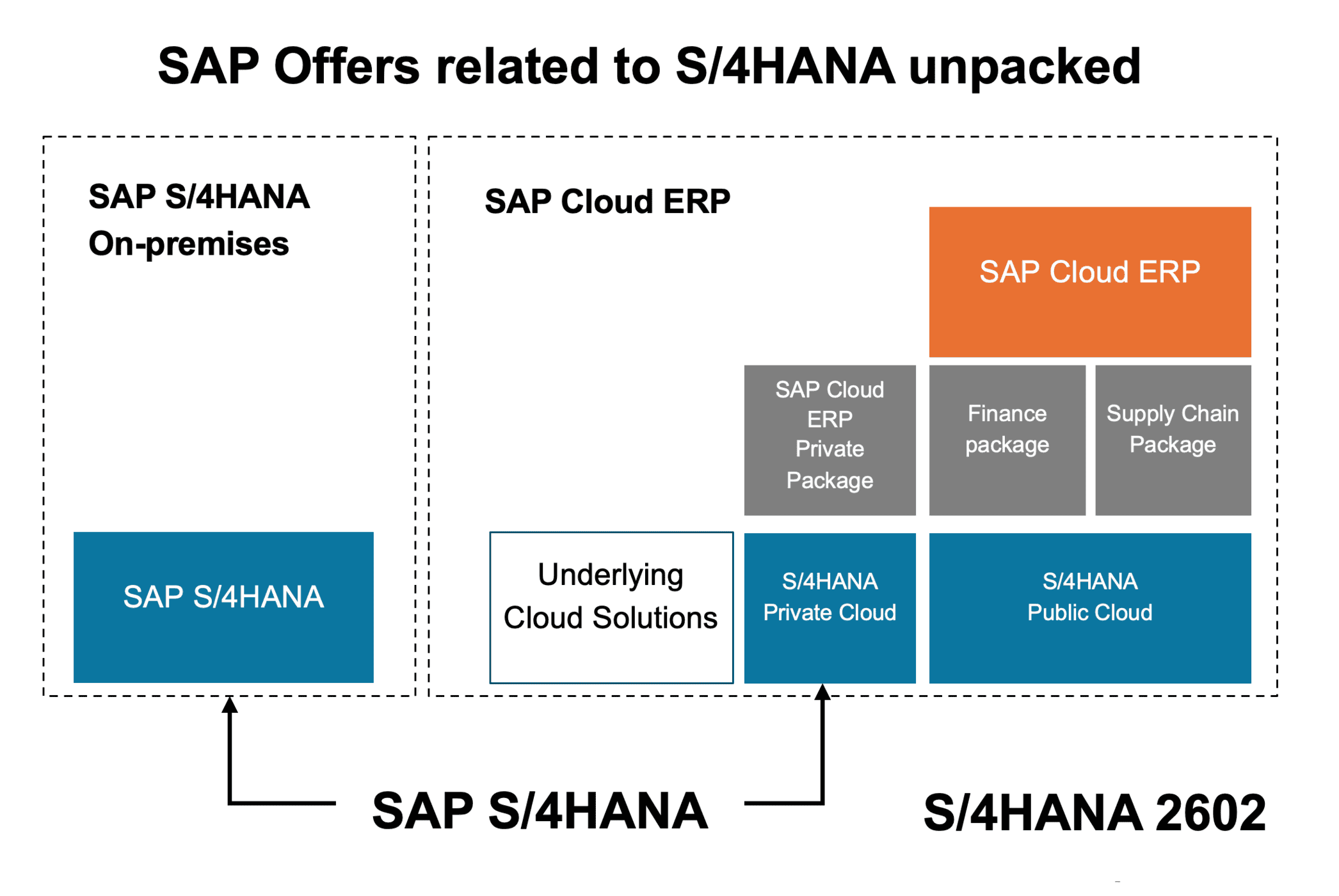
SAP’s rapidly evolving naming structure has become one of the biggest drivers of customer confusion. What was once called “S/4HANA Cloud” is now “SAP Cloud ERP,” subdivided into “Public Edition” and “Private Edition.” Behind these two offerings, there are two different versions of S/4HANA development:
- S/4HANA Public Cloud (latest release S/4HANA 2602)
- S/4HANA Private Cloud (latest release S/4HANA 2025)
Each has its own separate development path.
Meanwhile, the on‑premises version remains “SAP S/4HANA,” which runs on the same development cycle as S/4HANA Private Cloud on single-tenant implementations.
This branding shift has created several misconceptions in boardrooms and among IT leadership teams:
Misconception 1: “S/4HANA 2602 is the next version of S/4HANA.”
It isn’t. S/4HANA 2602 is a cloud‑only code line. On‑premises S/4HANA and S/4HANA Private Cloud have their own release cycle and receive only selective backported enhancements.
Misconception 2: “All SAP Cloud ERP customers get the same functionality.”
They don’t. Public and Private Cloud editions differ significantly in capability, extensibility and complexity. The SAP S/4HANA Cloud Private Edition follows the SAP S/4HANA (on-premises) release cycle because they are fundamentally the same software. Private Cloud customers — typically those who elected a brownfield migration — find themselves ineligible for innovations delivered with 2602.
Misconception 3: “Public Cloud is just the SaaS version of everything in S/4HANA.”
Public Cloud has a narrower functional scope, limited industry depth and strict Clean Core principles. Many advanced or niche processes are available only in Private Cloud or on‑prem releases.
What S/4HANA 2602 signals about SAP’s innovation strategy
SAP’s release of S/4HANA 2602 is less about functional breadth and more about directional intent. Though the release includes AI‑driven enhancements, cross‑suite integrations and usability improvements, the message is clear: SAP’s innovation engine now runs in the Cloud ERP landscape — and increasingly, it runs exclusively in the Public Cloud.
SAP’s rationale is based on its belief that AI‑driven applications, predictive analytics and automated end‑to‑end processes depend on cloud‑based models, harmonized data and continuous update cycles. Maintaining parity across deployment models no longer aligns with that vision.
For CIOs, the implications extend well beyond feature lists. The questions become:
- How are past architectural choices limited in their ability to access innovation today?
- Should organizations try to keep up with SAP’s trajectory, and how does that impact spend cycles?
- As SAP shifts the center of gravity toward Public Cloud, how does this affect my organization’s ability to navigate regulatory constraints, customization footprints and industry requirements?
What user groups and analysts are saying
DSAG reports that many long‑term SAP customers feel blindsided by the gap between what they were promised during SAP’s on‑premises S/4HANA adoption wave and what SAP is delivering today. ASUG echoes concerns about uncertainty, lack of clarity and inconsistent communication.
Further, a Freeform Dynamics research report revealed that 84% of the 455 organizations surveyed are apprehensive about SAP’s current messaging, and more than 90% worry about unpredictable pricing over time with SAP’s specific SaaS approach.
Analyst reactions mirror this sentiment. CIO points out unease about cloud lock‑in, escalating subscription costs and the unclear ROI of early‑stage AI features,[1] while The Register has highlighted mixed messages regarding pricing.[2]
User groups such as ASUG and DSAG have been explicit: Naming changes and fragmented roadmaps leave customers unsure of what they’re buying, what innovations they’re entitled to and how future‑proof their chosen deployment model really is.[3]
For CIOs, that uncertainty quickly turns into operational and reputational risk. When the business expects a specific innovation to be made available in its environment, only to discover later that it’s available only in the cloud, that accountability lands squarely on IT leadership. The result is an uncomfortable conversation with CFOs and COOs about how their very expensive, recently modernized on‑premises S/4HANA investment won’t receive the innovations SAP is promoting.
Staying current with SAP’s terminology shifts isn’t just about accuracy; it’s about maintaining credibility.
How to regain control of the ERP roadmap
Against the backdrop of SAP’s cloud‑only strategy, many CIOs are exploring alternatives — not to abandon SAP, but to regain control. Third-party support models, such as Rimini Street’s, are gaining traction by extending the life of existing SAP environments while freeing up budget and time to modernize at scale.
This approach resonates with CIOs for several reasons:
1. It breaks the forced march toward cloud upgrades
CIOs can stabilize on-prem ECC or S/4HANA for years, even decades, without needing to move into SAP’s subscription model before they’re ready.
2. It materially reduces operating costs
Organizations routinely cut SAP operating expenses by 50% or more through third‑party support, unlocking the capital needed to fund real innovation where the business benefits most.
3. It creates strategic breathing room
Instead of reacting to SAP’s roadmap, CIOs can modernize around their existing systems with composable architectures, best‑fit applications, cloud analytics, RPA, integration layers and next‑generation data platforms.
4. It preserves control and reduces lock‑in risk
CIOs maintain full autonomy over timing, sequencing, partner selection and architectural decisions.
5. It provides cost relief and roadmap control.
Cost efficiency, risk mitigation, innovation without overspending and the ability to deliver measurable business outcomes in 12–18 months are central to CIO priorities today — and they can all be achieved by adopting an alternative to SAP’s roadmap.
The logic is simple: If innovation isn’t accessible, why keep paying for it?
Rimini Street helps flip the equation — pay less for maintenance and invest more in meaningful transformation.
What questions CIOs should be asking now
Across the globe, CIOs evaluating S/4HANA 2602 are asking a consistent set of strategic questions:
- Is it worth following SAP’s Clean Core principles to leverage cloud innovations when doing so would eliminate customizations that provide a competitive advantage?
- Does Public Cloud realistically fit our industry, regulatory and process complexity?
- Is Private Cloud a worthwhile modernization path or an expensive hosting shift with hidden constraints?
- Is AI‑driven, ERP-only innovation mature enough — and valuable enough — to justify a lengthy, costly and disruptive migration to SAP’s cloud?
- How do we protect IT budgets from rising subscription costs and cloud lock‑in risk?
- Should we decouple innovation from SAP’s roadmap by modernizing around our current system?
- How do we maintain credibility with the business when SAP’s messaging shifts mid‑journey?
These are executive-level questions that can help shape transformation timelines, funding models, operating models and organizational capabilities.
Key takeaways
SAP S/4HANA 2602 demonstrates how SAP is steering innovation toward its Public Cloud platform and away from on‑premises and Private Cloud customers. Confusing naming and fragmented roadmaps only increase the challenge for those who need clarity, not ambiguity. But CIOs do have options. By stabilizing existing on-prem systems, reducing unnecessary spend and modernizing on their own terms, organizations can regain control of their ERP roadmap. Learn how third-party support and services for SAP from Rimini Street can reduce annual support fees by up to 50% while preserving choice, control and strategic flexibility.
[1] Grant Gross, “SAP customers not sold on S/4HANA ROI,” retrieved 20 February 2026 from https://www.cio.com/article/4082285/sap-customers-not-sold-on-s-4hana-roi.html
[2] Lindsay Clark, “Unwary SAP private cloud users face 10% renewal hikes, warns Gartner,” retrieved 20 February 2026 from https://www.theregister.com/2025/10/14/sap_private_cloud_hikes/
[3] Lindsay Clark, “User group says SAP’s licensing models make cloud migration harder,” The Register, retrieved 20 February 2026 from https://www.theregister.com/2025/09/19/sap_licensing_criticised_by_dsag_group/