
ERP trend #1: The monolithic ERP software model is being transformed by Agentic AI
Traditional, monolithic ERP software was built for stability — not speed or agility. As AI, automation and function-specific applications enter the market in droves, organizations are increasingly recognizing that legacy ERP platforms have reached their technical limits. In an era where decisions need to be made faster and more strategically, it’s clear that monolithic ERP systems alone can’t keep pace with how modern businesses operate.
What is a monolithic ERP system?
A monolithic ERP system — often referred to as a traditional ERP system — is a single-vendor platform that delivers core ERP functionality through one tightly integrated software suite of modules. It serves as a reliable albeit static “System of Record,” supporting transactional integrity, performance and compliance. As all modules share a central database and are highly interdependent, changes to one component typically require system-wide updates.
The limits of traditional, monolithic ERP systems
Traditional, monolithic ERP systems weren’t designed to orchestrate real-time business action across diverse systems. They were built to execute predefined transactions within a closed system. As a result, they struggle to meet the dynamic needs of modern enterprises.
The limitations of monolithic ERP systems include:
- Rigid architectures: The presence of tightly coupled modules makes it difficult to introduce change without leading to broad system impact.
- Slow innovation cycles: New capabilities are gated by vendor release schedules and upgrade cycles, preventing organizations from modernizing at their desired pace.
- ERP-centric execution: Traditional ERP assumes that business processes begin and end inside the system, despite modern workflows spanning multiple platforms.
Due to these barriers, many enterprises are shifting away from monolithic ERP as the primary execution layer.
How this trend is affecting the future of ERP
Realizing the limitations of monolithic ERP, organizations have begun moving toward Agentic AI-driven orchestration platforms that enable new “Systems of Action.” These platforms extend beyond ERP boundaries, using Agentic AI to connect business processes, data and decisions across applications and departments — meeting business needs that traditional ERP software can no longer support on its own.

ERP trend #2: Adoption of low-ROI ERP upgrades and cloud migrations is declining
ERP upgrades and cloud migrations with uncertain ROI are falling out of favor as enterprises reassess if and how to modernize their core systems. Existing ERP software remains operationally stable, while large-scale replacement projects introduce costs, risks and disruption without delivering proportional business value.
This trend is largely being driven by ERP vendors’ transition from perpetual-license software to subscription-based SaaS business models. As vendors increasingly tie AI capabilities, new innovations and even full support coverage to newer releases and cloud platforms, organizations are reassessing whether costly upgrades and migrations are truly necessary. Many are seeking ways to innovate and adopt AI while continuing to maximize the value of the systems already in place.
The rise of upgrade mandates from ERP vendors
Major ERP vendors such as Oracle and SAP often position upgrades and cloud migrations as strategic necessities rather than optional improvements — even when existing environments are stable and performing well.
ERP vendor upgrades often lead to increased operational risk, as such projects impact mission-critical systems supporting finance, supply chain and regulatory reporting, while simultaneously increasing long-term costs through subscription pricing and consumption-based fees.
A prime example is the current reality facing SAP ERP perpetual license owners. Those still running SAP ECC 6 are urged to upgrade or risk losing mainstream support, whereas S/4HANA perpetual customers are being told they must move to the cloud to access new capabilities. These mandates prioritize the vendor’s timeline over customer readiness, pressuring organizations to modernize at a pace that may not fit their business needs.
Why organizations are refusing
Many organizations are either delaying or outright rejecting mandated upgrades and migrations from ERP vendors. Some common reasons that they’re refusing cloud ERP upgrades include:
- Low or negative ROI: Customers don’t see the value of such projects because they don’t address pressing operational challenges and fail to deliver a meaningful ROI.
- Business disruption: Upgrades and migrations involve lengthy reimplementation, retraining and system instability — all of which can disrupt day-to-day operations.
- Misaligned priorities: Organizations want AI and automation benefits without overhauling systems that work and undergoing costly migrations.
Increasingly, leaders are recognizing that upgrading or migrating ERP isn’t the only — or best — path to innovation.
How this trend is shaping the future of ERP
Rather than accepting the old model of vendor-dictated upgrades and migrations to harness the power of AI, organizations are finding ways to optimize their existing ERP systems and innovate over the top. By treating ERP as a stable core within a composable architecture, enterprises can deploy Agentic AI ERP — a model in which:
- The ERP continues to function as a reliable, back-end transactional engine.
- Agentic AI takes over the execution, orchestration and automation of business processes.
- New AI capabilities are delivered without disruptive upgrades or migrations.
This approach enables organizations to access AI-driven innovation while avoiding the cost, risk and disruption of traditional ERP upgrade cycles — fundamentally shifting how ERP modernization is achieved.

ERP trend #3: Composable ERP is altering enterprise architecture
As traditional ERP systems struggle to keep pace with business change, organizations are rethinking how ERP fits into their overall technology architecture. Rather than being constrained on a single, monolithic platform, many enterprises are adopting a composable ERP strategy with best-fit solutions. This trend reflects a broader move toward flexibility, modularity and faster time-to-value without the disruption of large-scale replatforming and single vendor subscription lock-in.
What is composable ERP?
Composable ERP is an approach in which ERP is treated as a set of modular capabilities rather than a single, all-in-one system. Core financials and master data remain stable within the core ERP, while specialized functions are assembled from interoperable components such as:
- Microservices
- Packaged capabilities
- Industry-specific applications
- External platforms
The goal isn’t to fragment ERP randomly, but to design an architecture that allows organizations to adapt and evolve without repeated, costly system replatforming.
The origins of this model date back to the 2010s, when SaaS solutions began to unbundle the traditional ERP suite into smaller, function-specific components. By allowing organizations to mix and match best-fit applications, SaaS accelerated the shift toward composable ERP, giving enterprises more choice and greater architectural flexibility.
Drivers behind composable ERP
Several factors are accelerating the move toward composable ERP architectures, including:
- Vendor-driven subscription models: Major ERP vendors like SAP and Oracle appear to be pushing customers toward one-size-fits-all ERP solutions hosted on vendor infrastructure, reducing flexibility for enterprises as vendors exert full control over system design, timelines and innovation paths.
- An abundance of specialized solutions: The SaaS ecosystem now offers more function-specific solutions tailored to individual industries, roles and use cases than ever before. These options often outperform singular ERP modules in terms of speed, usability and innovation.
- Advances in data integration: Modern data orchestration layers and federated data fabrics make it easier for disparate systems to “talk” to each other and share data securely. Integration is no longer reliant on ERP-native tools, allowing interoperability to exist independently of the ERP vendor.
Together, these drivers make it both possible and practical to decouple innovation from the ERP core.
How composable ERP is redefining the future of ERP
Composable ERP enables organizations to innovate without destabilizing their most critical systems. With this strategy, enterprises can keep their existing ERP stable and layer new capabilities around it — adopting best-fit technologies while minimizing risk.
Benefits of composable ERP include:
- Greater architectural flexibility: Organizations can select and replace individual components as business needs evolve.
- Faster innovation: New capabilities can be deployed independently of ERP upgrade schedules.
- Reduced reliance on vendor roadmaps: Enterprises gain control over how and when they modernize.
As AI adoption accelerates, this approach becomes even more strategically prudent. Organizations that depend solely on their ERP vendor for AI capabilities are often trapped in disruptive, years-long upgrades or migrations that may yield negative ROI. In contrast, a composable ERP architecture allows organizations to pilot and scale AI-driven features surgically — delivering measurable outcomes and faster time-to-value without waiting for the ERP core to change.

ERP trend #4: Enterprises are adding a data fabric layer above multiple systems, including their ERP
It’s not merely ERP trends related to the systems themselves affecting the future of ERP, but the data within them. As enterprises pursue faster, more intelligent decision-making, the way ERP data is accessed and used is also changing. Organizations are shifting toward federated data fabric architectures that better support agility, scale and intelligence across the enterprise IT ecosystem.
Limits of the traditional data warehouse model
For years, the dominant analytics pattern involved extracting ERP data and putting it into a centralized data warehouse. This model enabled historical reporting and standardized analytics, and data warehouses continue to play an important role by cleaning, normalizing and optimizing data for analysis. However, organizations are increasingly questioning whether every piece of enterprise data needs to be centralized before it can be used.
The traditional approach is now being challenged by several factors, including:
- Data volume and velocity: The growth of enterprise data and the speed at which it’s generated make the warehouse model increasingly difficult and costly to maintain everything in a warehouse.
- Latency: Moving data into a warehouse often introduces delays, as many environments rely on scheduled refreshes that can limit access to real-time information.
- Governance complexity: Centralizing data from many systems increases the burden of security and compliance management.
- Limited context for action: Business decisions don’t depend solely on ERP data, yet traditional warehouses often struggle to incorporate timely data from external systems and applications.
With the need for faster, more contextual insights continuing to rise, organizations are complementing their data warehouses with architectures that allow data to be queried where it resides, rather than automatically centralizing every dataset first. Data warehouses are becoming one source within the broader enterprise data fabric rather than the sole destination.
What is a federated data fabric?
A data fabric isn’t a single database or repository. Instead, it’s an architectural layer that connects data across multiple sources — such as ERP, CRM, HCM, supply chain systems and external data — while applying consistent governance, security and metadata standards.
The “federated” aspect means that data can remain distributed in the systems where it’s created, yet still be discoverable, accessible and usable through shared policies and interfaces. It allows intelligence and analytics to operate across the broader ecosystem.
How this trend impacts the future of ERP
Federated data fabrics change how ERP supports insight and action. Rather than serving as the central data hub, ERP participates in a connected data landscape that enables faster, more informed decision-making.
Advantages of a federated data fabric include:
- AI-ready data access: AI agents can securely access and interpret data wherever it resides, turning intelligence into action without friction.
- Richer operational context: A data fabric connects various signals without forcing them into a single warehouse first, allowing organizations to leverage insights spread across systems with ease.
- More flexible AI adoption: Organizations can build AI-powered use cases, such as inventory optimization or cash forecasting, without waiting for every dataset to be centralized.
This trend shows that the future of ERP is less about owning all enterprise data and more about enabling intelligent access to it — supporting faster decision-making, smarter automation and the next generation of AI-driven enterprise systems.

ERP trend #5: Agentic AI ERP is the future of ERP
As enterprises move away from inflexible architectures and centralized data models, a new ERP operating model for the Agentic AI Era is emerging. Agentic AI ERP represents the culmination of ERP trends shaping the evolution of mission-critical software.
What is Agentic AI ERP?
Agentic AI ERP is an ERP model that reinvents how business processes are executed. It transforms ERP from a linear, transactional “System of Record” to a “System of Action” with Agentic AI capabilities. In this model, ERP remains an important contributor of trusted data, but it’s no longer the sole system where intelligence or execution resides.
Agentic AI ERP deploys intelligent electronic “agents” that can reason, set goals, make decisions and act autonomously — much like a human. These agents operate across systems and data sources, regardless of where data or application logic resides, and leverage a federated enterprise data fabric rather than being constrained to ERP data alone.
How Agentic AI reimagines the future of ERP
Traditional AI in ERP systems is primarily limited to generating insights such as forecasts, alerts or recommendations. Though valuable, these insights still require human intervention to turn analysis into action. As a result, execution remains slow, manual and often fragmented across various teams and systems.
Agentic AI, on the other hand, doesn’t stop at insight. It can execute complex business processes from end to end. Intelligent agents can interpret data, determine best actions, coordinate across the enterprise and complete workflows without continuous human oversight. This reduces manual effort, allowing employees to focus on higher-value, strategic initiatives.
In short, Agentic AI ERP is shaping the future of ERP by redefining what ERP systems are responsible for and how work gets done.
Practical Agentic AI use cases that include ERP
Agentic AI ERP delivers value by automating and orchestrating high-impact workflows across ERP software and surrounding systems. Real-world use cases of AI in ERP processes include, but aren’t limited to:
- Customer onboarding: Agentic AI can simplify customer onboarding by coordinating data, validations and approvals via automated form submission workflows — reducing cycle times and improving accuracy.
- Procurement requisitions: AI agents can manage requisition intake, policy checks, approvals and exception handling — accelerating procurement while maintaining governance.
- Delivery scheduling: Agentic AI can optimize delivery scheduling while enabling status tracking and generating associated documents with ease.
- EDI resolution: AI agents can detect, diagnose and resolve EDI errors by coordinating actions across ERP, partner systems and external networks — reducing manual effort and accelerating resolution.
- Work order management: Agentic AI automates work order creation, scheduling and tracking across operational systems, improving throughput and asset utilization.
- Financial reconciliation: AI agents can streamline the identification and reconciliation of financial variances — addressing discrepancies and accelerating close cycles with greater accuracy.
- Quality inspection management: Agentic AI coordinates inspections, captures results, flags anomalies and triggers corrective actions across ERP and quality systems.
By adopting Agentic AI, leaders can extend their ERP to optimize key business processes to achieve their operational and financial goals — ultimately driving meaningful business impact.
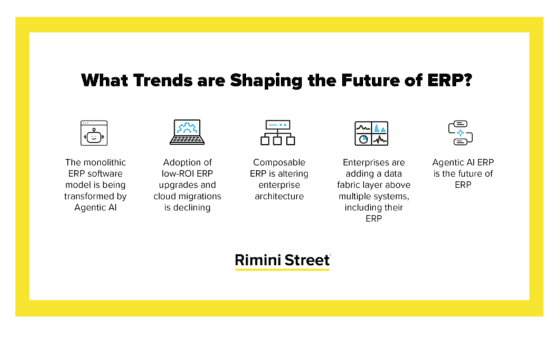
How these trends are shaping the future of ERP software
Together, these ERP trends point to a clear paradigm shift in how enterprise systems are evolving. Traditional, monolithic ERP platforms are no longer the primary drivers of innovation. Enterprises are moving away from low-ROI upgrades, adopting composable architectures and rethinking data access through federated fabrics — all while AI advances from insight generation to autonomous execution.
As a result, ERP’s role is changing. Instead of acting as the “center of the universe” for enterprises, ERP software is becoming a stable core within a broader IT ecosystem that supports:
- Modular innovation
- Cross-system intelligence
- AI-driven automation
Agentic AI ERP builds on these trends by transforming ERP from a passive “System of Record” into an active “System of Action,” thereby enabling organizations to modernize faster, innovate without disruption and unlock greater value from the systems they already rely on.
See more trends impacting the future of ERP
Our recent white paper, “The Rise of Agentic AI ERP,” provides an in-depth look at the disruptive, emerging trends in ERP software and Agentic AI on ERP, revealing how traditional ERP systems are giving way to a new iteration and what can be gained by leveraging Agentic AI to transform ERP processes. Read the white paper now.