What is the “SaaS-pocalypse?” It’s the widely reported idea of an impending, large-scale replacement of enterprise applications that rests on a simple premise: AI agents, custom AI applications and AI-native software could eventually replace parts of the traditional SaaS stack. If AI can perform work across internal systems, organizations may eventually need fewer cloud subscription licenses, fewer redundant applications and fewer vendor-controlled workflows.
The “SaaS-pocalypse” narrative is partly driven by the promise that AI can automate workflows, reduce dependency on traditional cloud application interfaces and help enterprises build targeted capabilities faster and more cost-effectively. It is also fueled by pressure on IT leaders to reduce application costs, simplify portfolios and find new sources of productivity. If AI agents can eventually perform work across multiple systems and roles, corporate buyers may need fewer user licenses, putting pressure on the traditional per-seat subscription model.
This scenario may prove true in some areas. There are non-core applications, narrow workflows and highly repetitive processes where Agentic AI can quickly create new options. But that doesn’t mean systems of record and the accumulated data in ERP systems can be replaced wholesale.
ERP is different because it’s more than a user interface or workflow engine. It is where institutional business logic, financial controls, compliance obligations, transactional history, master data, integrations and operational dependencies live. ERP is a perfect use case for applying incremental AI capabilities that can slowly decompose monolithic platforms, but not an overnight wholesale replacement. AI may change the experience layer first, but the system-of-record layer will remain deeply relevant for years.
Exploring the Gartner “SaaS-pocalypse” position in our view
This distinction matters because the real decision for CIOs is not whether AI will eventually change the application landscape. It is how to distinguish useful AI adoption from speculative replacement plans, especially in areas where systems of record, controls and operational continuity still matter.
Gartner recently weighed in on the growing “SaaS-pocalypse” conversation, and we feel its position is a useful counterweight to the market hype. In its report, “Enterprise Applications 2030: How to Respond to the ‘SaaS-pocalypse’,” Gartner asserts that “large-scale replacement of enterprise applications by Agentic AI is unlikely through 2030. Agent deployments work well for some use cases, but not for enterprise-wide, complex, or regulated use cases.” My read: the idea of an extinction-level disruption of SaaS is overstated, but the pressure to rethink enterprise application strategy is real.
That aligns with what I hear from CIOs, CTOs and application leaders globally. They are interested in AI-driven innovation and want faster insights, better automation and more intelligent ways to run the business. But they are not looking to gamble the enterprise on a wholesale ERP replacement strategy. With respect to ERP, the Gartner position that “Agent deployments work well for some use cases, but not for enterprisewide, complex, or regulated use cases.,” is especially important. As the transactional system of record, I see ERP as too critical and deeply embedded to replace wholesale with custom AI or AI-native alternatives at this stage. Agentic AI may reshape ERP strategy, but it does not make complex, highly customized systems of record disposable.
What we’re noticing is more and more IT leaders taking a pragmatic approach to AI: keep core processes such as general ledger, month-end close, procurement and supply chain execution on proven ERP systems, then add AI agents, intelligent engagement layers and custom AI capabilities around them where the value is measurable. Agentic AI is a new capability layer that should be introduced with discipline, governance and a clear business case. I see the winners not as the companies that replace everything the fastest, but the ones that know what to protect, what to extend and what to reinvent.
But there is a far more concerning risk for IT leaders to consider as they pursue AI-enablement.
The real risk: Following the ERP vendor’s roadmap
The “SaaS-pocalypse” discussion is usually framed around AI replacing SaaS applications. However, for many ERP customers, the more immediate risk is not replacement by AI. It is vendor-driven disruption.
Organizations are being asked to reimplement stable, secure and highly customized ERP systems onto subscription-based cloud platforms under the banner of transformation, end-of-support deadlines, access to innovation or AI readiness. In many cases, that means an expensive, disruptive subscription replatform that forces companies to revisit processes, integrations and customizations that are still working well. This is where a real “apocalypse” can show up for ERP customers:
- Loss of roadmap control and greater vendor dependency
- Forced subscription lock-in
- Cost escalation without clear business value
- Required reimplementation of stable, secure, fit-for-purpose systems
- Exposure to unpredictable token monetization and data toll bridges
From my perspective, the “SaaS-pocalypse” isn’t just about whether AI will replace SaaS. It’s about who controls the modernization roadmap. Organizations are opting for more modular, scalable, best-fit solutions that leverage AI for their specific needs, rather than generalized AI-for-the-masses. IT leaders aren’t turning away from innovation. They are turning away from the idea that innovation must be defined by a vendor’s timeline.
In fact, the smartest organizations I speak with are asking a better question: “How do we turn the ERP we already have into a stronger foundation for AI transformation?”
There is a practical path between “do nothing” and “replace everything.” The Rimini Smart Path™ methodology gives organizations that want to modernize on their own terms a structured way to assess where to support, optimize and innovate across their application estate so modernization decisions are tied to business outcomes rather than vendor timelines.
The path guides clients through a practical approach to modernization:
- Support: Use third-party support to minimize operational costs associated with back-office systems such as ERP systems. For example, Rimini Street saves clients up to 50% off annual vendor maintenance fees and up to 90% on TCO in some instances.
- Optimize: Protect the investments already made in business processes, customizations and integrations while keeping the systems running securely and reliably.
- Innovate: Add Agentic AI around the ERP core where it creates measurable business value.
We’ve found that this methodology helps organizations pursue AI functionality faster, with less risk and lower cost than locked-in cloud reimplementations. It creates a more flexible future-state architecture by matching the right solution to the right business outcome.
Brazilian retailer Ypê found that flexibility with Rimini Agentic UX™, an intelligent, AI-driven user engagement layer deployed over the top of existing ERP systems and releases, enabling a modern user, role and persona-based experience and automating workflows that leverage AI agents. CIO Geraldo Pereira explained, “Rimini Street is a true AI strategy partner because they work seamlessly with our CRM, ERP, HR systems and so on. We were able to achieve our AI goals very fast, and without high costs or disruption to the business.” His advice: “You can try Agentic AI right now ─ without big migrations, without big investments ─ with Rimini Street.”
“You can try Agentic AI right now ─ without big migrations, without big investments ─ with Rimini Street.” Geraldo Pereira, CIO, Ypê
In this model, ERP remains the trusted system of record, while Agentic AI serves as an intelligent engagement and execution layer around it. Targeted Agentic AI can then support differentiated use cases, with AI-native tools introduced selectively where they are mature enough and appropriate for the business need. Just as important, integration, governance and process ownership remain under enterprise control.
By adding capabilities incrementally, organizations can better manage risk, reduce chaos and control costs. The future is not ERP versus AI; it is ERP plus AI, governed by business value rather than vendor pressure.
The future is not ERP versus AI; it is ERP plus AI, governed by business value rather than vendor pressure.
Answering the wake-up call: How to respond to the “SaaS-pocalypse”
The “SaaS-pocalypse” conversation may feel overhyped, but it should still serve as a wake-up call for enterprises to rethink application strategy. It should not push CIOs into premature replacement or vendor-driven cloud migration. Leaders should be skeptical of modernization narratives that begin with an ERP vendor deadline rather than a business outcome. Though a “SaaS-pocalypse” may be far off, it shouldn’t derail a practical approach to AI enablement right now.
In the report, we see Gartner offering a scenario model outlining four broad response patterns to consider when building your enterprise AI strategy to avoid your own SaaS-pocalypse. The report provides more guidance and context on applying this framework to your AI planning.
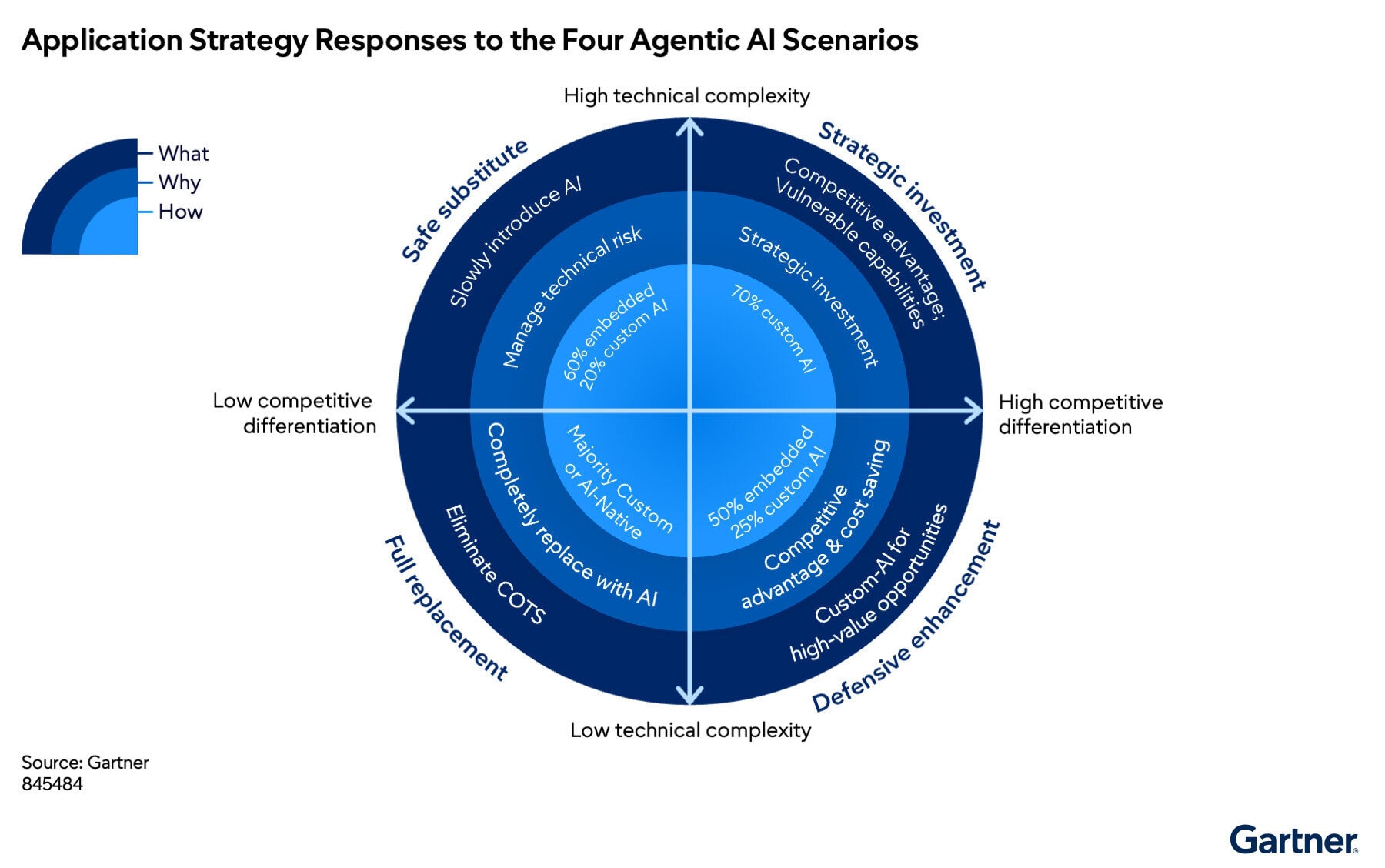
The real priority is to protect critical data and processes, prove AI value in targeted areas and build an AI-enabled roadmap that advances business goals without unnecessary disruption. AI readiness should be defined not by whether a company has moved to a vendor’s newest cloud platform. It should be defined by whether the enterprise can use its data, processes and systems to create measurable business value.
We believe that the Gartner analysis of the “SaaS-pocalypse” and its scenario modeling guidance can help you plan a practical path for enterprise AI transformation.
Download the complimentary report here
Key Takeaways
Despite the “SaaS-pocalypse” hype, large-scale ERP replacement by AI is unlikely in the near term. The more immediate risk for IT leaders is allowing vendor roadmaps to dictate costly, disruptive cloud replatforming under the banner of AI readiness. A smarter strategy is to protect trusted ERP systems while adding Agentic AI where it delivers measurable value, governance and control. The goal is not to choose between ERP and AI, but to build an AI-enabled application roadmap on business terms.