

On paper, the traditional Application Management Services (AMS) outsourcing model sounds simple: offload incidents, service requests, routine tasks, and IT backlogs to an outsourced vendor to free up internal IT staff. But the reality? It’s a tangled web of rising ticket volumes, ballooning costs and diminishing returns. Instead of driving transformation, the internal IT team is stuck overseeing a multitude of vendors, juggling service-level agreements (SLAs), mediating disputes and managing escalations — all of which forces innovation to take a back seat.
So why do companies continue to spend on services that seem like a very expensive black hole — consuming both budget and the internal IT teams they are meant to set free? A modern application management outsourcing approach that integrates managed services with support provides a strategic advantage for both IT and finance teams, as it unlocks the true value AMS was meant to deliver.
The traditional AMS outsourcing model is broken
The current, industry-standard approach to AMS outsourcing is riddled with inefficiencies. This approach is outdated, overly complex and is built on fragmented structures that separate application management from support, rather than integrating the two functions.
Governed by a time and materials contract structure, the traditional AMS model is charged by ‘man-hours’ with no provision for root cause problem management. Instead of permanently solving problems, vendors continue to log tickets and record billable time of staff for “incident handling,” perpetuating a cycle of reactive support.
Problems with this AMS model have been well-known for years — leaving companies with bloated AMS agreements originally negotiated based on continuous upgrade cycles. Historically, SLAs steered the agenda as costs and output were measured against them, as opposed to considering ROI.
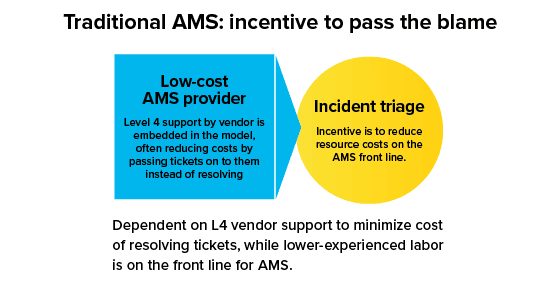
Compounding the issue, some AMS vendors underprice their services by relying on low-cost, inexperienced, high-turnover resources and shifting the work to the customer’s ITIL Level 4 ERP vendor support resources.
In this situation, AMS vendor resources are incentivized to reduce costs on the AMS front line by triaging support tickets to the ERP vendor rather than permanently fixing the underlying root cause of the issue. The very same problems organizations are paying the AMS vendor to solve are instead boomeranged back to the internal IT team to address.
For these AMS vendors, managed services is a loss leader — a low-margin offering designed to open the door to more lucrative consulting, project, and development work. It commences inconspicuously as the provider learns more about the customer’s digital agenda. This ‘land and expand’ approach often manifests through a steady stream of change requests, continuous upgrades and scope creep, with the IT team potentially paying more — or paying again — for what the organization already owns.
In this scenario, a client may begin to hear imaginary cash register sounds and vendor observations such as:
- “That service is out of scope …”
- “You will need a new release to be able to do that …”
It is no surprise that the traditional AMS outsourcing model falls short of its promises. Rather than streamlining operations and prioritizing functional outcomes, it contributes to operational drag and a bloated IT backlog — the very issues it intends to resolve. IT and finance leaders must ask themselves, “Are we getting actual value from our AMS services, or just hours and hours of ‘trying’ as a veil for manufactured project and consulting work?”
There is a better AMS outsourcing model that delivers real results
An integrated AMS and support model that is centered on root cause issue resolution and is supported by a comprehensive, well-structured support catalogue delivers significantly better results for IT and finance leaders than the traditional AMS model. In this framework, AMS layers are tightly integrated across ITIL Levels 2-4 support, eliminating dependency on embedded ERP software vendor support and ensuring consistent service delivery under one expert provider.
Instead of running up more man-hours or shifting the work — and blame — to ERP vendor labor resources, an integrated AMS and support model is focused on investigating and permanently resolving the root cause of recurring issues. This approach reduces incident volumes and improves service quality and operational efficiency. Combined with automation for recurring service requests and routine tasks, this approach drives better business outcomes and lowers total cost of ownership.
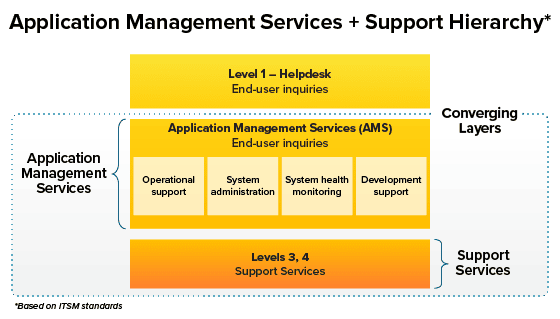
Pairing AMS with independent L4 support has deep benefits that go beyond fixes. Here, frontline AMS teams are empowered to reduce overall service costs by focusing on root cause analysis and permanent remediation. Meanwhile, L4 support delivered by the same partner resolves the more complex issues, including those occurring with customizations, through tight coordination, communication and handoffs.
This integrated approach ensures continuity, eliminates finger-pointing and fosters a shared commitment to client success. The result is a service experience defined by exceptional quality, proactive care and measurable client satisfaction.
Benefits of the integrated AMS outsourcing and support model
There are many advantages to the integrated AMS outsourcing and support model versus traditional AMS support models:
- Faster, more efficient incident resolution
- Root cause analysis and permanent remediation of issues, rather than repetitively resolving the same issues
- Comprehensive support that takes on customizations with ease
- Internal IT teams are freed to focus on strategic, revenue-driving initiatives
- Elimination of manufactured project work
- Strategic and proactive support replaces reactive, ticket-based service
- Highly skilled, experienced, and accountable resources
- Performance is evaluated, with compensation tied to client satisfaction
- Focus on eliminating backlog and maximizing the value and longevity of existing systems
- Improved operational productivity with reduced operational friction
- No inflated ‘man-hour’ billing
- Budget, resources and time savings are unlocked to fuel innovation
A robust, integrated AMS and support model empowers organizations to extend and maximize the lifespan and value of their current IT investments. It ensures alignment with the functional, operational and business priorities of today’s modern enterprise needs, delivering support that is both future-ready and business-focused.
Rimini ONE™: A proven integrated approach to AMS outsourcing
Rimini Street’s integrated support offerings: Rimini Support™ for independent enterprise software support services and Rimini Manage™ for application managed services – empower organizations to effectively fill IT skills gaps, streamline operations and elevate team performance. Together, these services deliver measurable efficiency gains, enhanced productivity and improved business outcomes.
At Rimini Street, we are a globally recognized leader of third-party support, application managed services and Agentic AI ERP innovation solutions for Oracle, SAP, VMware, Workday, ServiceNow, Dayforce and hundreds of other software applications through our Rimini Custom offering. Our global team of 1,100+ unmatched engineering experts helps organizations reduce overhead costs, boost profitability, and protect the uptime, security and reliability of mission-critical software, databases and applications —with confidence.
For Sunway, one of Malaysia’s largest conglomerates, the move to Rimini ONE™ translated into accelerated innovation and growth for the business. CIO, Kevin Khoo, remarked, “Rimini Street has enabled our acceleration in digital adoption journey by providing cost savings which we reinvested back into technology initiatives, has given us peace of mind with our system support needs, and confidence in our ability to explore new opportunities because we know Rimini Street will always be able to support us.”
Key takeaways
The traditional AMS model is broken — plagued by inefficiencies, inflated costs and a lack of value and accountability. Rimini Street has reimagined what support and managed services should be, pioneering a modern, integrated AMS and support model that puts client success at the center.
Don’t settle for less when it comes to your operational support needs. You’ve got options, and Rimini Street will get you there.
Explore our full range of integrated AMS and support services for SAP, Oracle, Dayforce, Workday, ServiceNow, Salesforce® and hundreds of other software, ERP and databases.